Why “Drop-Proof” Cases Still Break
Your phone slips from your hand, hits the floor, and you pick it up expecting the case to have done its job. Then you notice a crack across the screen or a chipped corner. The packaging promised drop protection. What went wrong?
The answer lies in the difference between tested protection and a guarantee against every accident. A case can reduce the force reaching your phone, but the outcome depends on where it lands, what it hits, and how well the case fits. Understanding those details helps you choose a better case.
“Drop-Proof” Is a Claim, Not a Promise
When a case carries a drop rating, the number generally refers to a particular test setup. A manufacturer may drop a phone in its case from a specified height, onto a specified surface, in a defined set of orientations. If the device passes the chosen criteria, the case earns that rating under those conditions. The result is useful information, but your next accidental drop may happen differently.
Consider two falls from the same height. In one, the phone lands flat on its back. In the other, the screen edge strikes the corner of a stone step. The height matches, yet the force is concentrated in a much smaller area during the second fall. A small point of contact can be more damaging than a broad impact, even when the phone travels the same distance.
Ask what was tested, which phone model was used, how many drops were performed, and what counted as passing. One successful controlled fall does not prove that every phone will survive every fall.
The Angle of Impact Changes Everything
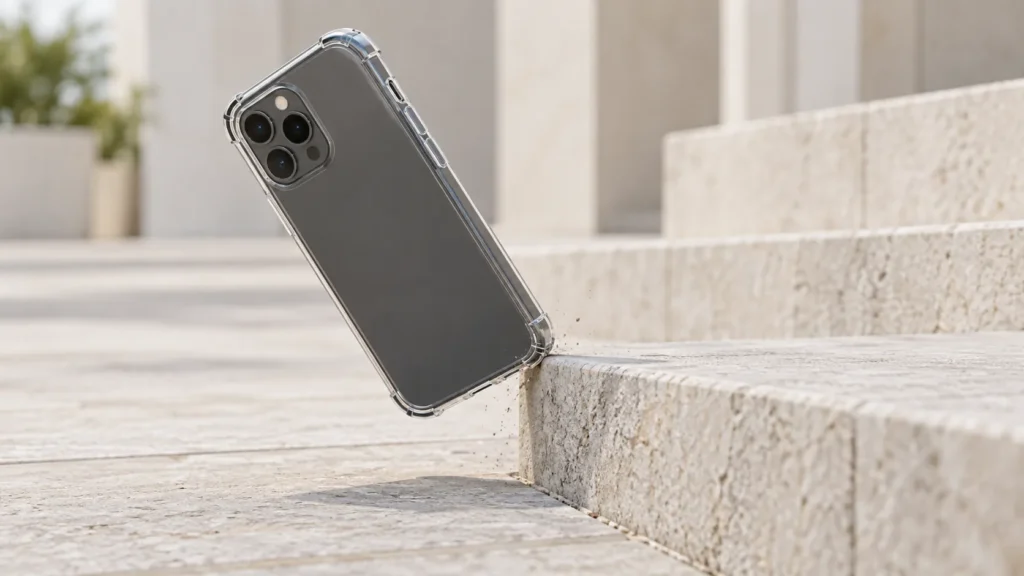
A case has several jobs during a drop. Its edges need to remain around the phone, its corners need to manage impacts, and its structure needs to limit the shock transferred to delicate parts inside the device. Where the phone lands determines which part of that system is tested first.
Corners are especially demanding. When a phone strikes on one corner, the impact energy enters through a small area. If that corner has little cushioning or the phone can shift inside the case, more force may reach the frame and glass. Screen and camera protection present another challenge: raised lips can create space between these surfaces and a flat floor, but they cannot keep a protruding rock from touching the glass directly.
The surface matters, too. Carpet can absorb part of the impact; hard, uneven gravel may concentrate it. Read a drop rating alongside the case’s corner coverage, raised edges, and fit.
Materials Must Manage Force, Not Just Feel Tough
A hard shell can resist scratches and help a case keep its shape. A softer bumper can deform briefly when the phone lands, helping to spread out the impact. Neither approach automatically makes a case safer on its own. Effective protection depends on how the materials work together and whether they stay in the right place around the phone.
Thickness alone can be misleading. A bulky case with thin corners, loose edges, or large unprotected cutouts may perform worse in a particular fall than a slimmer case with carefully reinforced impact areas. A flexible case that feels comfortable in your hand may also offer less protection if it stretches over time and no longer grips the device firmly.
Look at the corners, the transitions between rigid and flexible materials, and the coverage around the screen, camera, buttons, and ports. A case should be easy to install without feeling loose.
A Good Case Can Lose Protection Over Time
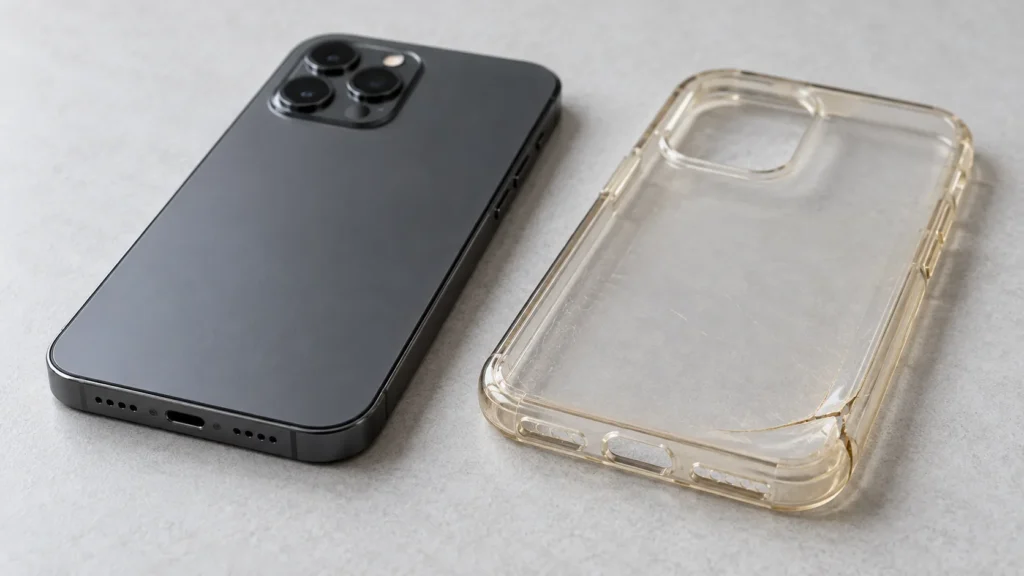
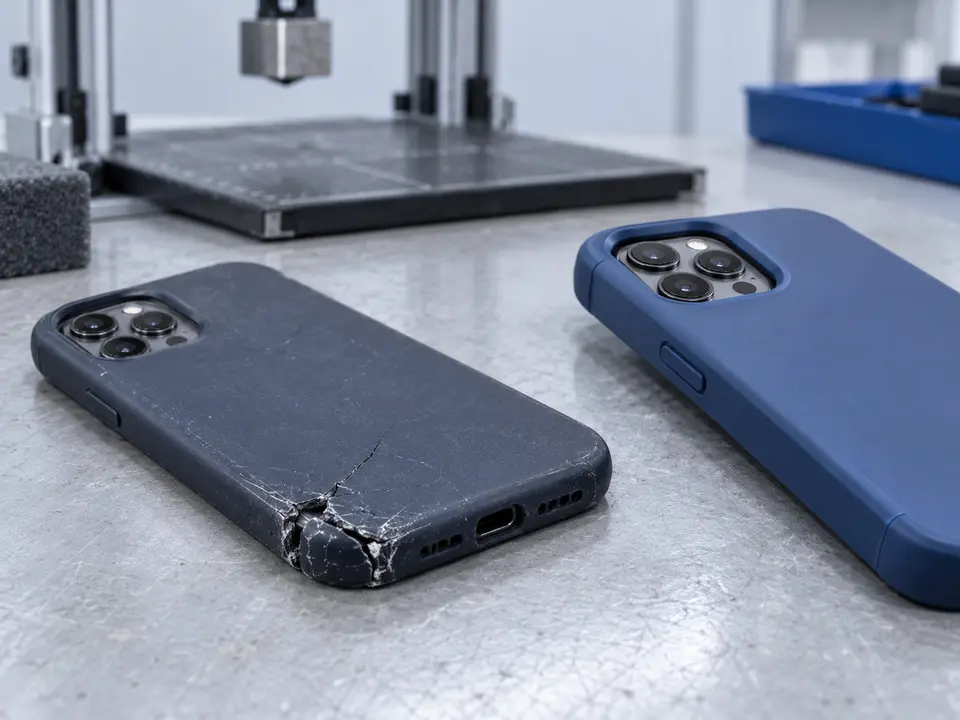
Drop performance is not fixed forever. Repeated falls can damage a case even when no crack is visible. A bumper may become compressed; a rigid section may develop a hairline fracture; an adhesive joint may loosen. Heat, sunlight, and everyday handling can also change how some materials feel and fit over time.
The phone may carry a history of its own. A previous drop can leave a tiny crack or weaken an edge, making a later fall more damaging than expected.
Check the case regularly. If a corner is split, an edge pulls away, or the phone moves inside it, replace it. Remove trapped grit, since hard particles between the case and phone can scratch surfaces and interfere with a close fit. After any serious drop, take the phone out and inspect the case as well as the device before putting it back on.
Read the Test Conditions Before You Trust the Number
Drop standards give manufacturers a repeatable way to evaluate products. For example, OtterBox describes testing connected to MIL-STD-810G and repeating drops across its case ranges. That detail is more informative than a bare “military grade” label. Different brands may apply tests differently, so read a rating in the context of the actual method and product.
Look for the tested height, surface, number of drops, device model, and impact directions. Check whether the result concerns damage to the case, the phone, or both. A number without an explained test gives you little to judge.
Match protection to the customer’s routine. Someone working around concrete or carrying a phone outdoors may need stronger corner coverage and more secure edges. A screen protector can add defense against direct contact with a sharp object.
Better Protection Starts With Better Questions
No case can remove every risk from a falling phone. The practical goal is to reduce the chance and severity of damage across the accidents you are most likely to encounter. Start with a case made for the exact device model, then examine its fit, corner design, screen and camera clearance, and stated test conditions. Check its condition as you use it.
For brands and wholesale buyers, clear product information builds more confidence than an absolute promise. Explain how a case is built, identify what has been tested, and describe the limits of the claim accurately. Customers can then choose a design that fits their phone and daily routine.
The next time you see “drop-proof,” read past the headline. The useful question is not whether a phone can ever break. It is how the case handles a real impact, how that performance was checked, and whether the protection still fits the phone when the unexpected happens.